I’ll be honest, I didn’t get along with Sekiro: Shadows Die Twice when it was first released. I found it too impenetrable, the difficulty curve too steep, the punishment for failure too harsh for the game to be enjoyable. But, with the world stuck in quarantine, I decided to give Sekiro another shot. I would try my best to finish a game that I had previously decried as good, but not good enough.
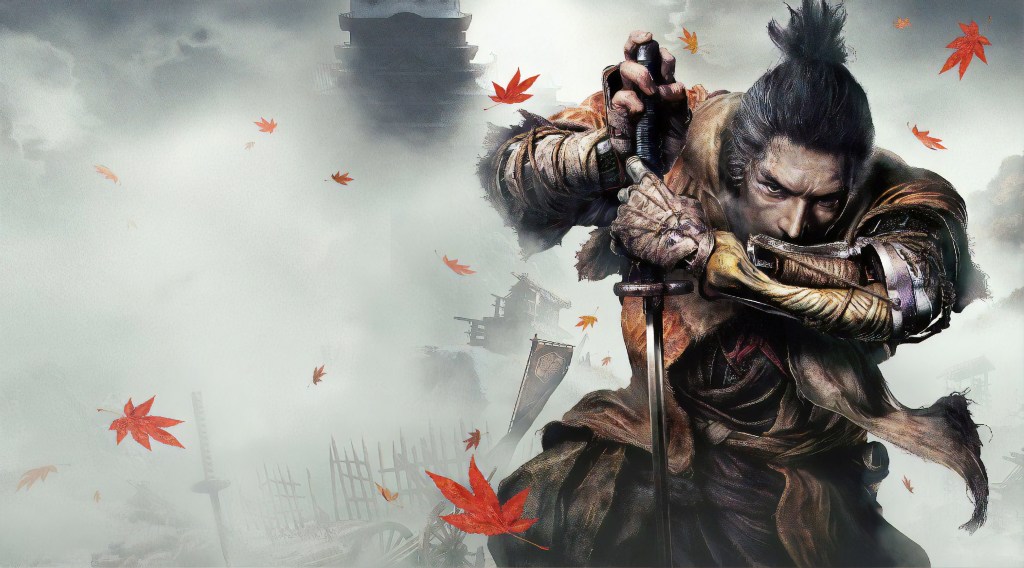
Set in a fictionalised version of Japan at the end of the Sengoku era, Sekiro follows Wolf, a shinobi who is pledged to protect the divine child Kuro, a being with supernatural powers including immortality. While attempting to flee Japan with Kuro, Wolf is separated from his liege by the warlord Genichiro Ashina, who also severs his left arm. Equipped with a powerful new prosthetic arm, and possessing the ability to return from the dead, it is up to Wolf to take on the Ashina clan, rescue Kuro, and enact his revenge on Genichiro.
–
Structurally Sekiro is very different from the Souls-borne games that preceded it. While there are similarities, carefully placed checkpoints that respawn enemies when rested at, a healing item that replenishes at those same checkpoints, a focus on storytelling through item descriptions, contextual location clues and enemy placement, there are significant changes, both in how Sekiro plays and the way it tells its story. It is structured far more like a traditional action game. While Dark Souls used numerous short cuts to funnel the player back to bonfires after they had completed a difficult or long combat encounter, Sekiro instead places checkpoints after every few groups of enemies, doing away with shortcuts entirely. Sekiro is also far more vertical than Dark Souls, with the player unlocking a grapple mechanic early in the game’s run, allowing them to quickly zip to ledges, buildings and even enemies.
But that is just how the level design differs. What about actually playing the game? Well, Sekiro is a much faster-paced game than Dark Souls. While the Souls games focused on blocking, and Bloodborne needed the player to master the art of dodging at the correct time, Sekiro instead focuses on parrying attacks. Every enemy has a posture meter that goes up when the player successfully parries an attack. When it is filled out the player can perform a deathblow, instantly killing the enemy, with certain bosses requiring multiple deathblows before they are taken out for good. The game also does away with stamina management, you can swing your sword or sprint as much or for as long as you might need. No, you don’t need to worry about getting out of breath, but you will have to ensure you don’t leave an opening that an enemy could potentially exploit…
Thematically, Sekiro has similarities to the previous From Soft games, but I won’t discuss them here. The themes found in From Software’s games would require a whole different article dedicated to picking them apart and examining them, and as much as I would love to tackle that challenge, I think it would be best to leave it for the current moment. I might return to it at a later date, who knows.
–
But I need to discuss the points I mentioned above; the reasons why I couldn’t get on with the game when it was first released, most of which have to do with some of the game’s mechanics. For starters, the high skill ceiling, especially when compared to Dark Souls. While Dark Souls is known for being challenging, it is easy to mitigate this difficulty somewhat. There exist countless internet guides that can aid a new player, and they all have similar advice: find a good shield, upgrade your gear, summon help if you need it. It is possible to make things easier. But these aren’t options in Sekiro. While there are tools that can help swing fights your way, the number of them can be overwhelming, and the tools themselves are often very situational. Instead, players need to focus on getting the timing right when parrying, which itself can be difficult, especially with large enemies or ones that don’t use swords.
But it isn’t just the skill ceiling that is off-putting about Sekiro, the aforementioned punishment upon death is also a factor in my initial dismissal of the game. When Wolf dies and is unable to be resurrected by Kuro, he will respawn at the nearest Sculptors Idol, minus half of the player’s collected money and EXP. While it is easy enough to collect money, which isn’t even used that often until late in the game or to buy specific items, the loss of EXP is brutal. It is possible to lose all of the EXP that you have collected from killing a mini-boss, denying the player valuable skill points and abilities that would make the game easier, and unlike in Dark Souls, there is no way to recover lost EXP. But that is just the tip of the iceberg. Complicating things are two mechanics, Unseen Aid and Dragonrot. Unseen Aid is a mechanic which, upon death, gives the player a 30% chance of retaining all of their money and EXP. This percentage chance is affected by Dragon’s Rot, a status effect that the player accumulates each time they die, representing a mysterious disease linked to Kuro’s immortality bestowing powers. The more the player dies, the more the Dragonrot spreads, infecting almost all of the secondary characters that Wolf has met. But herein lies the issue. While Dragonrot lowers the chance of Unseen Aid being activated, the activation rate can never be raised above the initial 30%. That, and the fact that one of the items required to cure Dragonrot is in finite supply, means that it often feels like the game is discouraging the player from playing the game and making mistakes. It feels like the price for failure is too high. While Dark Souls II also had a high punishment for failure, with each death slowly whittling away the player’s maximum health down to 50%, it never felt as unfair as Dragonrot. Part of this is because the materials required to reverse the health loss in Dark Souls II, while also finite, are still more bountiful than the Dragon’s Blood Droplets in Sekiro. And, because Dragonrot affects the NPCs in a visible way, reducing to coughing, pained shadows of their former selves, it adds a level of guilt whenever another character contracts it. Whenever my character’s health was reduced in Dark Souls II I was annoyed, but I never felt guilty; I was being punished for my own mistakes. But the same cannot be said for Sekiro, and that taints my feelings on the mechanic.
–
Having struggled all the way to the end of Sekiro, I find it difficult to know what to write. My thoughts on the game haven’t changed much. The problems that I had with it are still there, and replaying it has done nothing except highlight them to me. Mechanics such as Dragonrot and Unseen Aid still feel unfair, especially near the end of the game when upgrade materials are more expensive. But, as much as I might try to deny it, the game does feel incredible to play. There is nothing quite like timing a series of parries perfectly, sparks flying as Wolf’s blade dances in the air. The high skill ceiling means that the moment of overcoming a difficult boss, or of returning to an early area to bully all of the enemies that once picked on you, feel incredibly sweet in. Levelling up in this game isn’t achievable by increasing stats or upgrading equipment but by the player mastering the mechanics and practising the timing of their parries.
As I write this I’m stuck on the final boss. He feels like a wall, one that I don’t know if I’m going to be able to scale. I’ve already spent tens of hours fighting my way through Sekiro, but when I see this final boss, standing so tall and mighty in a sea of white flowers, I feel daunted. Scared. I’ve tackled him a few times already, but I’ve been unable to even scratch him, his sword sailing through the air faster than I can register. I don’t know if I’ll ever beat him. But I feel like I should try, even if it takes a while.
As I’ve said, I’ve already given tens of hours of my life to Sekiro. What difference does a few more make?
 Correspondence From Limbo
Leave a comment