In his article Une Ville Secrète (A secret city), writer Julien Green stated that he believed that there are two different versions of Paris:
“Paris is a city that might well be spoken of in the plural, as the Greeks used to speak of Athens, for there are many Parises, and the tourists’ Paris is only superficially similar to the Paris of the Parisians”.
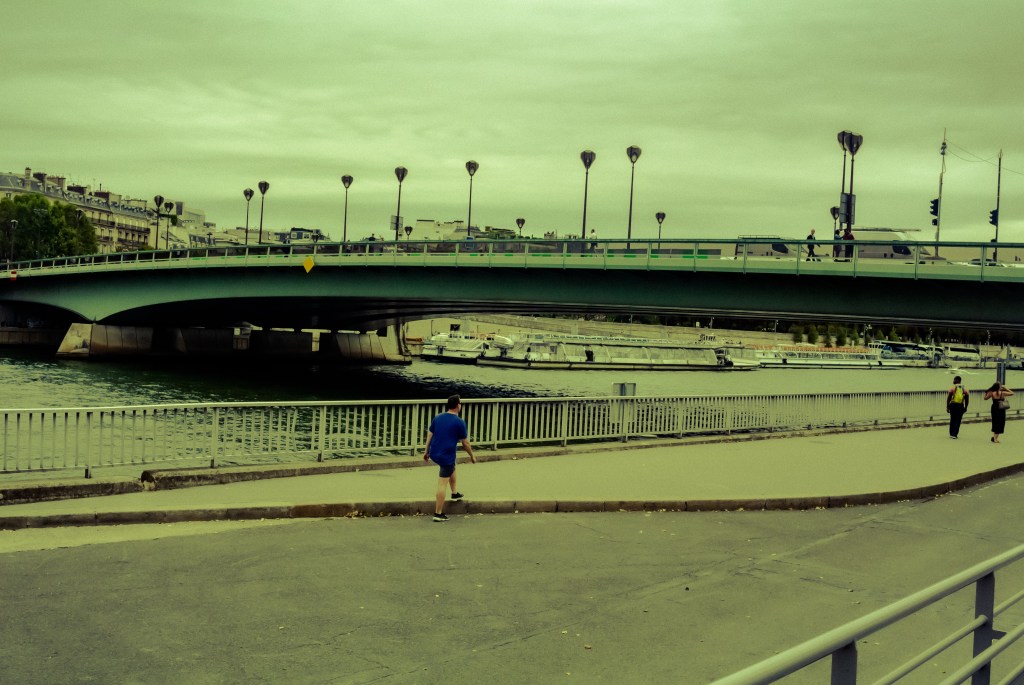
How much of this is true I will never know. Unlike Green, I have only ever experienced Paris as a tourist, once when I was young, travelling with my family, and again a short year ago when I visited the city by myself. It was my first time travelling on my own, without family or friends to fall back on if I got lost, or to help me understand a language that I barely speak.
I can only look at Paris from an outsiders point of view, something that I feel Green would have been ashamed of. During my second visit, the one I shall be detailing here, I revelled in the tourist attractions that one might expect of Paris; the Eiffel Tower, the remains of Notre-Dame, the stained-glass windows of Sainte-Chapelle. Green made his thoughts on these monuments clear in J’ai bien des fois rêvé d’ écrire… (I have often dreamed of writing…), wishing the Eiffel Tower to “the bottom of the sea”, but admitting that he is “struck dumb by Notre-Dame”, envious of those who have the courage to tackle writing about such a giant.
It is J’ai bien des fois rêvé d’ écrire… that serves as the introductory chapter of Green’s 1984 book Paris, which was what inspired me to go to Paris in the first place. Or, at least, the cover did. The contents of the book are fine, a collection of Green’s writings on Paris from the early ’40s, but it was the cover of the Penguin Modern Classics edition that sparked my imagination. A simple black and white photograph showing a corner of two intersecting streets, the cover promised adventure and excitement, getting lost on unfamiliar city streets, haggling with street vendors. It promised adventure. It promised small bookshops, beautiful architecture, wine with dinner, tender romances. It pledged all this, as well as a feeling of wonder and discovery. A feeling I wanted to chase.
–
My feet were killing me. I’d been in Paris for about two hours, and in that time I’d realised that the shoes I had bought with me, canvas boots with thin soles, were completely unsuitable for city walking. The bottom of my feet were covered in blisters, which turned walking any distance into an endurance challenge.
What didn’t help was that I had spent most of those two hours walking the wrong way. After I had alighted from the Eurostar, I had diligently entered the name of my hotel into Google Maps, in the hopes that it would plot me a route that would allow me to quickly and easily find me accommodation for the next few days. The issue was, my phone’s initial direction was to leave the station through the southern exit and head south. As someone who isn’t in the habit of carrying either a map or compass, and whose grasp on the French language is tenuous at best, I decided, in a rather belligerent and, dare I say, British fashion, that the southern exit would be whichever one I was closest to. So I exited through what, in hindsight, appears to be the eastern door.
And subsequently headed north.
It didn’t take long for me to realise my mistake but, by then, I was well and truly lost. My phone was struggling to keep track of where I was, and every course correction it gave me seemed to send me through an increasingly confusing maze of side streets and back alleys. Whenever I emerged on the other side of these suggested routes, my phone would change its mind, either sending me back the way I had came or in another completely random direction. I shudder when I think of how I must have looked to observers; a completely ill-prepared tourist lost and alone in a city where he didn’t speak the local language and who was beginning to subtly limp as he marched up and down the same street, pulling his luggage behind him.
Eventually, Google Maps and I came to an agreement and I made my way to my destination; a small hotel not five minutes away from the Place de la République.
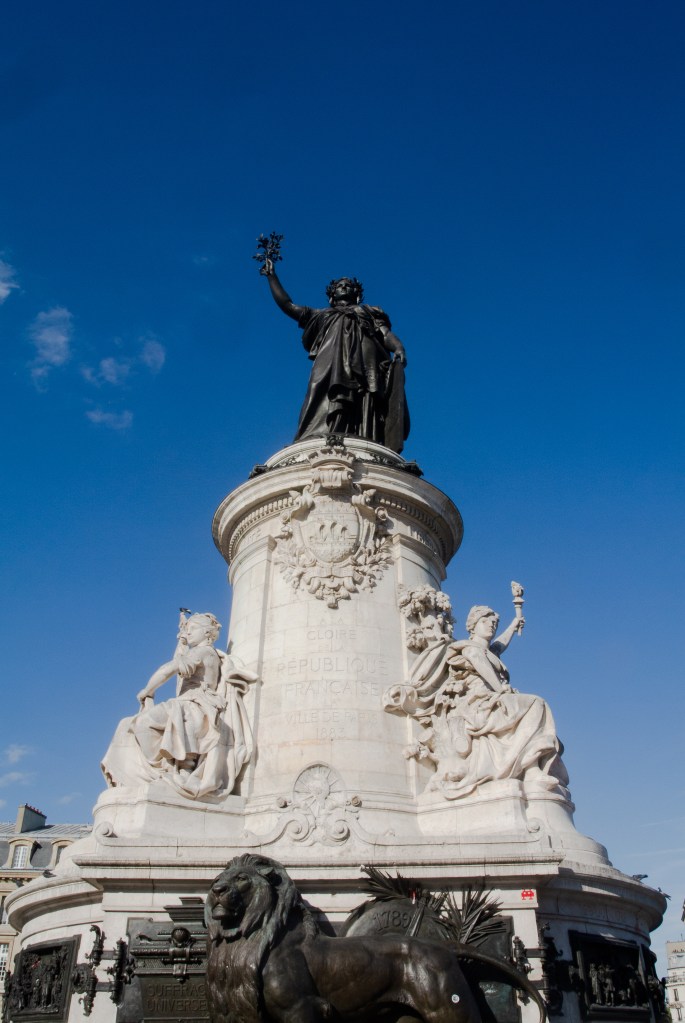
Let me pause for a moment while I describe the Place de la République. It’s a large square, situated at the border of three different districts. A large statue of Marianne, the personification of the French Republic, dominated the square, which is surrounded by shops and restaurants. Car and buses crawled by, people driving here and there on their daily commute. But the majority of the square is pedestrianised, dominated by young people hanging out and skateboarding, showing each other new tricks, flirting, chatting, being cool. Environmental activists stopped passersby to ask for donations for a variety of causes. People sat outside the aforementioned restaurants, drinking coffee or, as the day was slowly creeping towards evening, beer.
It was everything that I had come to Paris to find.
After checking into my hotel room, my first task was finding something to eat, something easier said than done. I had a limited budget of cash with me, and while I did bring means of accessing more funds if necessary, I didn’t want to use those if I could avoid it. It meant that I would have to find places to eat that were cheap, but still nice. It took me a while to find a suitable place, heading from restaurant to cafe, examining menus and checking prices against my budget. I had to be careful; I still had three more days in Paris, and other dinners and lunches to worry about. But it was during this period of time that I stumbled into another problem that I hadn’t adequately prepared myself for.
My lack of French.
I only managed to achieve a D on my French GCSE, so, suffice to say, I’m not extremely confident in it. I used to joke with my friends that the only phrases I know are “Hello”, “Goodnight” and “I’m very sorry, I’m English”.
This trip would reveal the truth of that joke.
My lack of French meant that, when I eventually stumbled into my chosen restaurant, part of a chain if the laminated menu’s and tacky flooring was any indication, I had no idea how to order my food. I eventually resorted to pointing the items I desired, too embarrassed to even attempt to speak more than I was confident in saying.
“Bonjour”. “Bonne nuit”. “Désolé, je suis Anglais”.
–
My second day in Paris was probably the easiest to label as “touristy”. My itinerary for the day did list several prominent tourist destinations: Sainte-Chappelle, The Eiffel Tower, the Shakespeare and Company bookshop. I set off early, after having a rather bland breakfast at the hotel. The weather was hot and bright, and I soon began to curse my lack of sunglasses. I had developed a sneaky feeling that I wasn’t prepared for this trip.
My first stop was Sainte-Chappelle. Despite the fame of the chapel’s stained-glass windows, I hadn’t actually heard it before I started planning for my trip. I didn’t really know what to expect as I set off on that hot, early September morning. Needless to say, I wasn’t disappointed.
Located on the Île de la Cité, almost opposite Notre-Dame, Sainte-Chappelle is a majestic sight. Protected by security guards and iron gates, it took me a while to actually access the chapel, but I was entranced the moment I ascended to the upper floor and laid my eyes on the famous stained-glass. I spent far too long trying to take a photo that properly captured the majesty of that miracle of glasswork, but all my efforts came up short. Eventually, I had to move on.
It would be remiss of me to not talk, however briefly, about Notre-Dame.
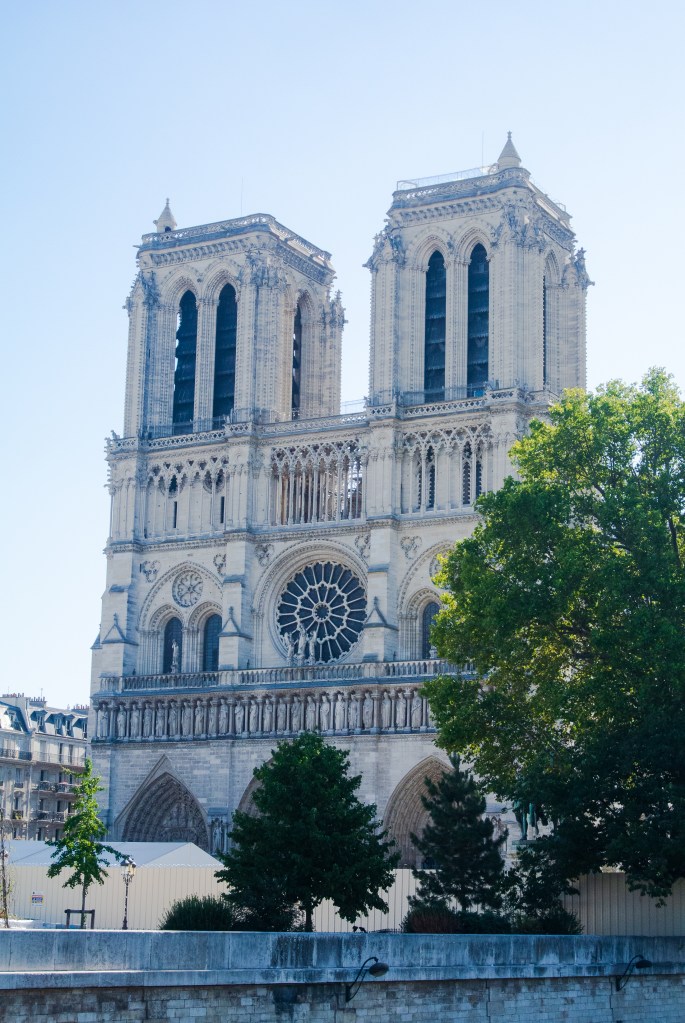
I wasn’t actually able to get close to Notre-Dame de Paris when I visited Paris. You probably know the reason why; the fire that ravaged it in April earlier that year. Barricades and walls were still erected around the site, keeping people away from the teams of workers who were attempting to make the area safe. I was standing so close to the world-famous cathedral, but it felt like I was still in a different country. As I paused outside Notre-Dame, alongside others who had came in hopes of maybe catching a glimpse of a historic building, I felt a twinge of sadness. I had never been to Notre-Dame, but it had inspired so many stories, touched so many people, that I felt upset by proxy. After the reports of the fire became known to the wider world, a lot of people took to Twitter and other social media platforms to share their stories of visiting the cathedral. While it was easy at the time to dismiss these stories as the experiences of incredibly privileged individuals, standing there I found myself disagreeing with that assessment. Architecture can inspire a dizzying array of thoughts and feelings in the observer, it can touch people in so many different ways. Hell, I’ve already mentioned how much awe I’ve felt as I walked through Paris’s streets. After meditating on this, I moved on.
I had other places to visit before the day was done.
It was in the Shakespeare and Company bookshop that I experienced the closest I’d get to my Parisian dream.
Let me stop for a moment to describe Shakespeare and Co. It isn’t far from Notre Dame and Sainte-Chappelle; It’s a short, five-minute walk across the Île de la Cité to the Left Bank where the book store is located. Despite Google Maps’ directions, I still struggled to find it, but, then again, that is easy to explain.
The shop is hidden in plain sight.
Despite the prestige that the shop has, the storefront blends into the rest of the street. Carts full of second-hand books block the shop from view, but after pushing past them, the first thing I noticed was how small the shop was. Unlike Sainte-Chappelle, I had heard of Shakespeare and Co. before my trip. I had expected something flashier, featuring columns and statues. I hadn’t expected a shop that was easy to walk past and ignore. But I really wasn’t prepared for what awaited me inside Shakespeare and Co. Once again, my expectations did not match reality; I had expected tidy shelves and a sterile environment, all the better for keeping such weighty tomes preserved. What I found was a cramped maze of books, full of cubbyholes, discarded books and storage systems that seemed to defy what I previously thought possible. Shelves formed doorways, requiring you to pass both by and under books to proceed. The deepest room I found looked like it had been carved out of the side of a cave.
Needless to say, I was in heaven.
I explored every inch of Shakespeare and Co. in a rush of excitement. I flicked through books, peeked into cubbyholes, drank in the atmosphere. I picked up a second-hand book of children’s ghost stories, tantalisingly entitled A Banquet for Hungry Ghosts, and triumphantly took it to the till to pay.
“How’d you like the shop?”, the man behind the counter asked.
“I loved it!”, I exclaimed, before asking how one went about getting a job at such an establishment.
“Just check out our website”, the man replied. “But do so before Brexit, okay?”
I thanked him, promised him that I would, took my new book and retreated to the book shop’s cafe, located just off to the site to store. After ordering a cold drink and finding a table, I quickly opened my phone and went to the Shakespeare and Co. website. But, as I looked at the requirements for new employees, my hopes were dashed.
They needed to be fluent in French.
I consoled myself by engaging in one of my Parisian fantasies, reading a book in a cafe with a cold drink. I sat for almost an hour reading through the excellent graphic novel Persepolis by Marjane Satrapi, in preparation for an upcoming university module on film and television adaptation of books. It’s a great read, one I would heartily recommend. A biographical account of Satrapi’s life, from her childhood in Iran to her exodus in Vienna, I was enthralled by the book, devouring it. After I finished it, and with the morning slowly turning to early afternoon, I paid up and left Shakespeare and Co.
The Eiffel Tower awaited.
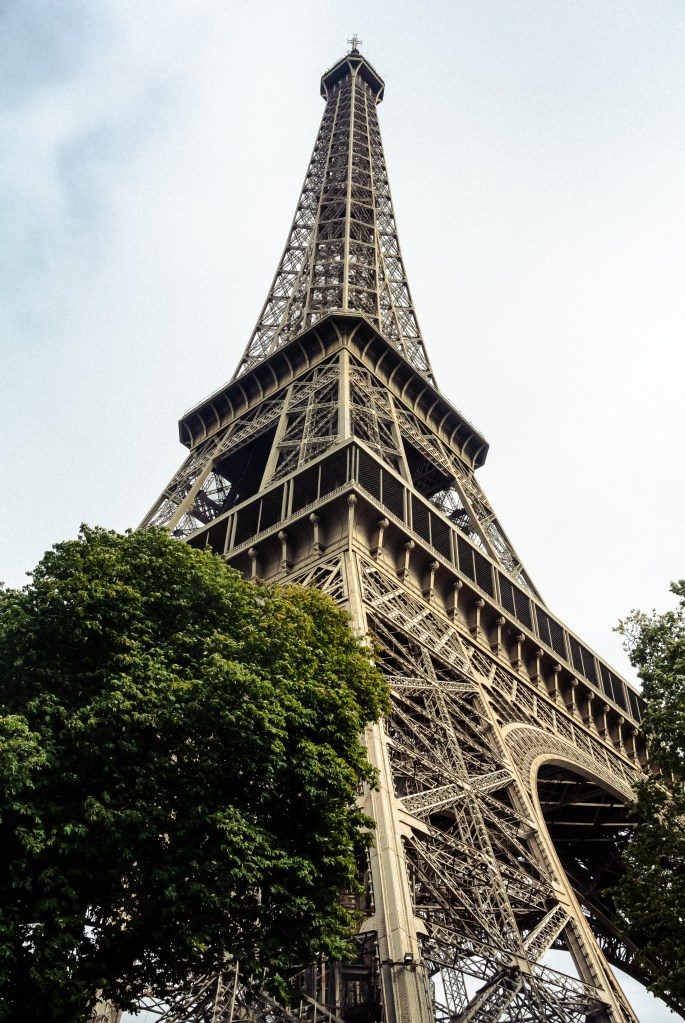
It’s hard to overstate how large the Eiffel Tower is, both physically and as a symbol of France. Standing at 324 meters, it is the tallest structure in Paris. It dwarfs everything around it. It’s an imposing presence, and I rather shamelessly gawked at it as I waited for the elevator which would take me to the higher floor. I had booked to visit the tower in the late afternoon, hoping that I would be arriving just after the crowds. Unfortunately, this wasn’t the case, and it soon became clear that the elevator ride up the tower was going to be incredibly cramped despite my plans to counter this. On top of all this, dark clouds were appearing over the horizon, threatening to unleash a downpour on the unsuspecting city below.
But, despite all this, I still found myself completely enraptured by the tower.
One of the things that amazed me was how many street vendors had made their home around the base of the tower. As I walked to the gate I saw, here and there, people sitting on the ground, blankets spread before them, each one selling little commemorative key chains and models of the tower that remind me of the ones from The Lavender Hill Mob. It was incredible. I hadn’t seen anything like it.
But the most stunning aspect of the tower is, inevitably, the view from the top. After waiting for fifteen minutes, and following an uncomfortable elevator ride, I soon stood at the top of the Eiffel Tower. Well, I didn’t actually make it to the top, as I have a crippling fear of heights, but I did make it quite far up the tower before I lost my nerve. But, regardless, I was still treated to a stunning of Paris. I took photos, admired the view, and left.
–
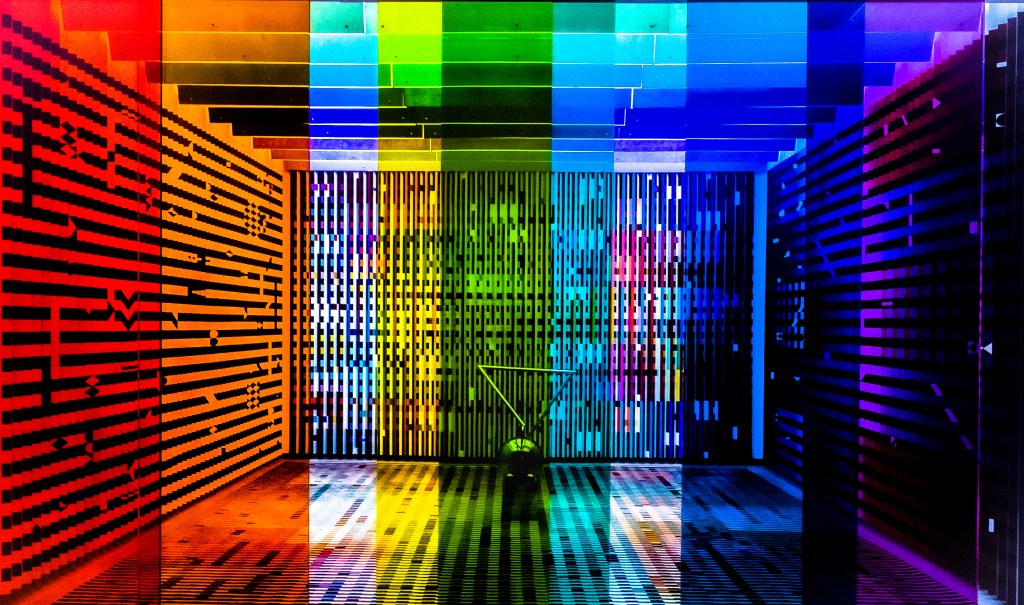
The Centre Pompidou looks like it’s unfinished. A large blotch of “high-tech architecture” in the middle of an otherwise traditional Parisian street, it sticks out like a sore thumb. It’s is so out of place that I initially believed it to be an unfinished football stadium upon first laying eyes on it, all exposed scaffolding and visible pipes and metal.
But if the exterior looks like a stadium, the inside of the Centre Pompidou is reminiscent of a super villain’s lair. Everywhere I looked there were white, featureless walls, neutral lighting and wide, open spaces. It felt a bit surreal. The exhibition I saw was located on the second and third floors of the building and reaching them required going up several escalators that were close to several large windows, showing me a lovely view of the surrounding Parisian neighbourhood. Standing at the top of those escalators, looking over the city below, before turning around and being greeted by several pieces of priceless art gave me a taste of what it must be like to be a billionaire CEO of a large, globe-spanning company.
I wish I could remember what the exhibition was on, but I honestly can’t recall either the themes that the Centre’s curators where attempting to invoke, or the names of the artists they were showcasing. I do remember making my way back down through the building, each floor revealing a new trove of beautiful or interesting artwork, all of which I wanted to admire.
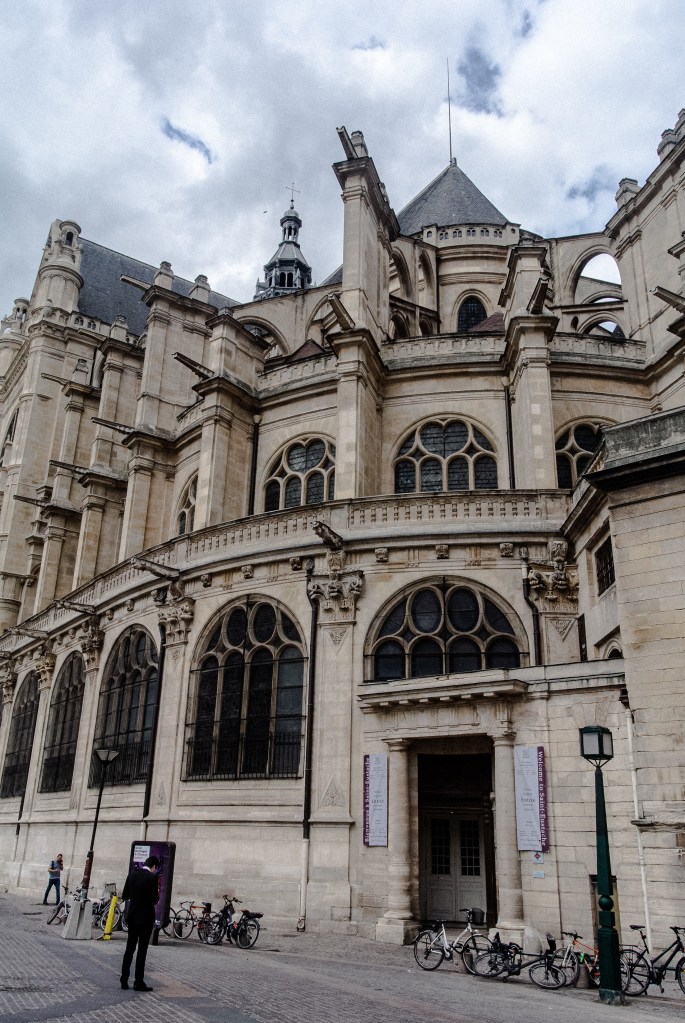
After leaving the Centre Pompidou I found myself wandering through the streets of Paris. I wasn’t searching for anything in particular, just aimlessly walking. This was when I came across Saint-Eustache. In a city full of amazing architecture, this comparatively small Gothic church, located about half an hour away from the Centre Pompidou, somehow got under my skin. I spent some time there, basking in the atmosphere. It reminded me of the churches I would visit with my family when we went abroad, and I filled up my camera’s SD card with pictures of Saint-Eustache.
I hope that one day I can find my way back there.
–
My last day in Paris is the day that I can remember the least. I didn’t really do much, just explored the area around Place de la République and searched for gifts for some friends back home.
I walked down side streets and sat in small parks, waiting for the time I would have to empty my hotel room and return to the train station to begin the long journey home. Eventually, the time to say goodbye to Paris came, and I walked back to the Gare du Nord. My return to the station was far smoother than when I had first arrived, and I couldn’t help but think of the parallels between those two treks across Paris. When I had arrived I had been nervous, afraid of what would happen, but I was leaving a more confident individual.
I had survived Paris. I felt like I could survive anything.
–
I’ll be honest, deciding to write a travelogue on a trip you took almost a year ago is probably not a good idea, especially when you didn’t take notes while you were there. I had kept a diary while I was in Paris, but I didn’t update it as much as I should have for it to be a useful resource as I wrote this. Oh well, I guess that there is always next time.
Something that you will probably have noticed while reading this account is the fact that it doesn’t go anywhere. Well, it does go places, it hops from place to place with the speed and excitement of a startled rabbit, but it never dwells. Part of that is the aforementioned year between my visit to Paris and me writing this, but part of it is because, and I cannot state this enough, just how unprepared for Paris I was. When I look back at my time there, what I normally think of is the amount of time I spent in my hotel room playing Gris (an excellent game that I both started and finished during my time away) and how long I spent walking from place to place, listening to music and podcasts.
I still have my copy of Julien Green’s Paris. I re-read it as I was preparing to write this piece, and it still inspires the same feelings in me now as it did when I first saw it, sitting alone in a bookshop. One day I might return to Paris and retrace Green’s steps. I might see how Paris has changed between him putting pen to paper and me walking those same streets.
Maybe one day.
 Correspondence From Limbo
Leave a comment