This is Travels in Limbo, my irregular column where I write about some of the more interesting places in games. These may be post-apocalyptic wastelands filled with half-demolished buildings or fantasy kingdoms stuffed wall to wall with magic, mystery and dudes in increasingly impractical armour. The game I’m looking at in this article is Hollow Knight, developed by Team Cherry and available on PC, Nintendo Switch, Xbox One and Playstation 4.
I’ve explored a lot of apocalypses. From the rusted wastelands and ruins of Destiny to the once majestic castles of Dark Souls, I’ve walked in a lot of dead worlds. Each one has stories, mythical half-remembered tales of what the world used to be like before whatever fall, collapse or war reduced the world to ruin. You get good at putting these disparate scraps of lore together, puzzling out the different people and groups that were significant to the world that was, how they and their beliefs or politics or actions shaped the world whose ruins you now stand in.
Darks Souls has a story about great men who became afraid of losing their power. Fallout weaves a tale of war and people giving into their destructive impulses. Destiny has you visiting planets which humanity once ruled before enemies and darkness forced them back to Earth. Hollow Knight is about… bugs? And weird moth angels? Huh.
I’ll be honest, I’ve struggled to put Hollow Knight’s story together. But I also felt like I didn’t have to; the game conveys everything the player needs to know about its world through tone and world design.
You’re constantly descending in Hollow Knight, forever spiralling further down, down, down, into the depths of the earth. This isn’t a unique structure; Dark Souls also had players descending through catacombs and disease filled sewers. But what makes Hollow Knight’s Hallownest different from Lordran is what lies below the surface. For starters, Hallownest is largely intact. Instead of crumbling ruins or destroyed castles, the areas that the player travels through are mostly still whole. Old stag stations and forgotten mines are still functional, despite being abandoned and in some cases overgrown. There are even a few people who are holding on in this near-dead kingdom. The war-like mantises still live in their village, unaffected by the events happening in greater Hallownest. One of the great knights still rests beneath the capital city, on guard against any threat. Holdouts remain, and while the game’s tone is still bleak, it at least feels more optimistic than some of its contemporaries.
Hallownest is comprised of a dozen different areas, from the overgrown Greenpath to the mines of the Crystal Peak and the oppressive darkness and horrific monsters of Deepnest. Each of these areas feels unique and memorable, either through how the levels are laid out, or the unique enemies or challenges that they introduce. But despite how well crafted these areas are, none of them are my favourite area of the game. No, my favourite area is one that is relatively small. It doesn’t contain many enemies; the ones that do appear also inhabit several of the game’s other locales. The area doesn’t have a unique gimmick either. No, it’s just a large room, filled with a big lake. But the area in question, the Blue Lake, is my favourite area in the entire game, mostly because it is linked to my favourite character; the explorer Quirrel.
You meet Quirrel quite early on in Hollow Knight. He’s in a mysterious building not too far from the melancholy town of Dirtmouth, examining a large egg. He tells you that he is travelling Hallownest in order to see its wonders, and his journey does indeed often intersect with yours. He can be found exploring the once majestic Queen’s Station near the Fungal Wastes. He waits for you at the top of Crystal Peak. You come across him as you descent into the Mantis Village, and sitting on a bench at the Lake of Unn. In each of these encounters, he is kind and encouraging, and often very thoughtful. In a game where the side characters you meet are either dismissive or outwardly hostile towards you, Quirrel is one of the few friendly faces you meet.
One of the places where you meet Quirrel is in the City of Tears, the capital of Hallownest. As the name suggests, rain is constantly falling upon the city; filling aqueducts and canals, falling into gutters and drowning out any noise but the pitter-patter of drops hitting roof-tops and cobblestones. You come across Quirrel sitting on a bench, watching the waterfall over the city. But this moment of peace summons several questions to the forefront of Quirrel’s mind – the City of Tears is underground, where is the rain coming from?
It’s a question that the player will discover the answer to pretty soon in the game: a large reservoir, the Blue Lake, is resting above the city, the water slowly draining out and falling onto the city below.
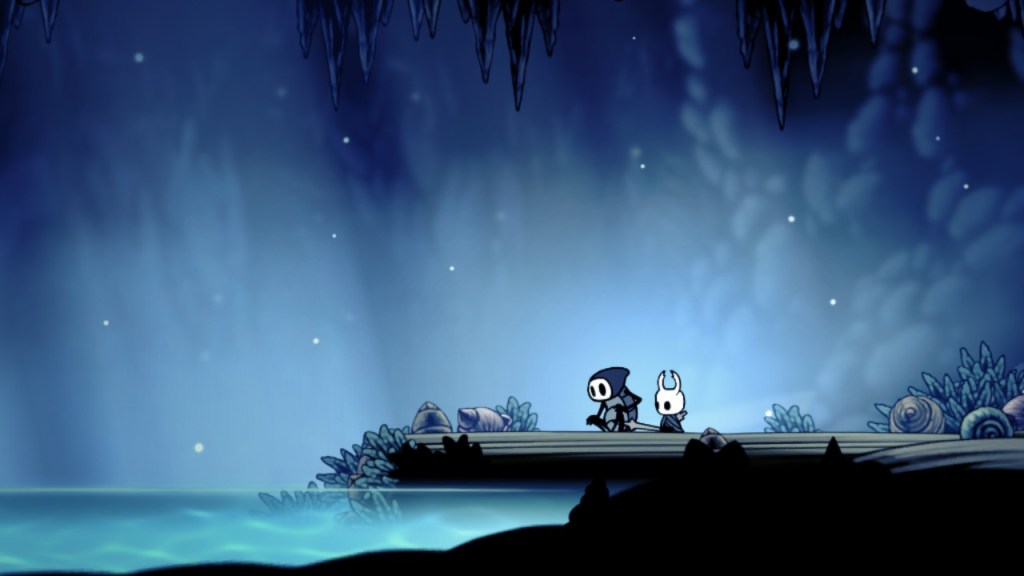
But it takes Quirell far longer to discover the answer to his question, and by the time he does everything has changed. He has discovered a great truth about himself and, depending on how you’ve played the game, you have too. He marvels at the great reservoir, it’s luminescent blue water stretching as far as the eye can see. He thanks you for the aid you gave him, celebrates the marvels you have both seen. And then he sits, along the bank of the reservoir, looking out over all the water.
You have the option to sit with him if you want. This isn’t part of a cutscene; whether or not you sit with him is entirely up to the player. If you do, then the two of you don’t exchange words; he has nothing left to say, and you have no mouth with which to speak. So you sit, in silence, for as long as you might wish, watching the water and enjoying each other’s company.
It’s a moment that you don’t have to end. But it does; Quirell has a new journey to undertake, and you have a duty to fulfil.
But until then, the two bugs sit on the beach, watching the bright blue water.
 Correspondence From Limbo
Leave a comment