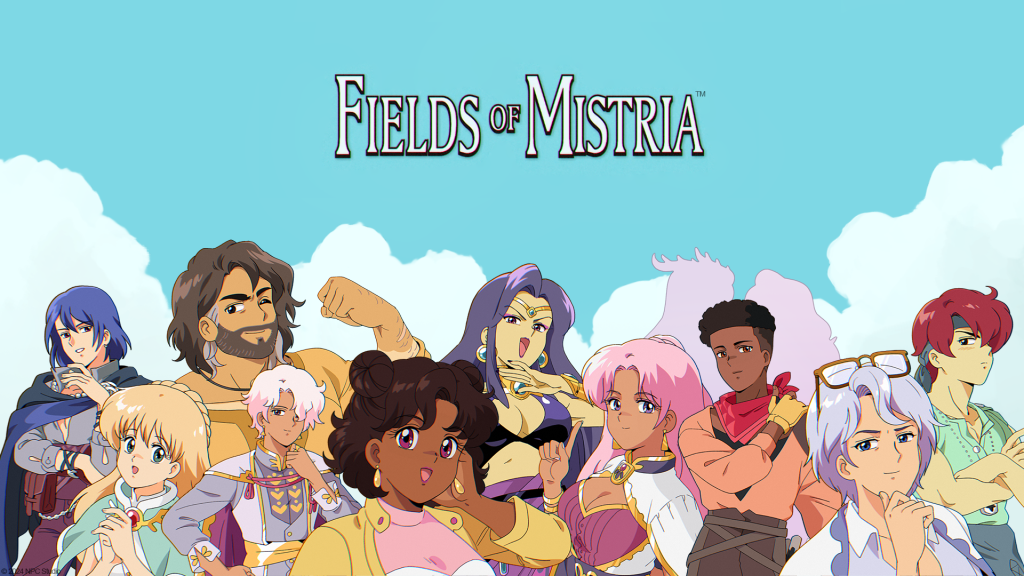
I wake up to the sound of a cockerel crowing. Looking at the clock, I see that it’s 6am, the same time I have woken up at for months. Crawling out of bed, I look around the small house that has been my home since I moved here. It’s sparsely decorated, not quite spartan but also not yet mine. Decorating will come later – for now, I need to harvest the crops I’ve planted, and then decide what to do with my day. I could go mining, or maybe hang out at the beach. Reina invited me to go shopping with her, but Valen also sent me a letter reminding me that I need to see her for a check-up. Alternatively, I could go to the forge and do some metal working with Olric (annoying March in the process), or see if Balor needs any help moving goods.
I sigh, and stretch, and head for the door. Sunlight pours in as I open it and stand in the doorway, looking over the fields that I have come to call home. I think of all the possibilities the day brings. And head out to go and meet them.
–
It should come as no surprise that I am a big fan of Stardew Valley.
It is a great game to unwind with. It’s very charming, the stakes are low, and the characters are almost all fun to be around (the dude who runs the local supermarket not included). Similar to roguelikes such as Risk of Rain or games that I’m intimately familiar with such as Dark Souls, it acts as a good podcast game, something I can play whilst listening to Remap Radio, Just King Things or Friends at The Table. I can happily while away the hours fishing, visiting the town or exploring the mines, delving ever deeper in search of treasure and riches.
But, after playing Stardew Valley for almost 150 hours on PC and countless more on Switch, there is little left in the game that actually surprises me. Using mods such as Stardew Valley Expanded or Ridgeside Village does add new contend, it also makes the game too big leading me to spend most of my time traversing a larger map. There is yet to be any sign of just when Haunted Chocolatier, the follow-up game from ConcernedApe will be released, leaving me in a bit of a limbo with the game.
Enter Fields of Mistria, a game developed by NPC Studio that I fell in love with as soon as I saw it. There’s something about the game that feels magnetic, more so than its closest comparison Stardew Valley.
That is probably the most apt comparison, Stardew Valley and Fields of Mistria (Harvest Moon/Story of Seasons is also a good comparison point, but I have less experience with those games outside of accidentally killing my sisters’ chickens because I forgot to feed them when I was six). Fields of Mistria does a lot of the same things that Stardew Valley does – you play a newcomer to a small rural community, who takes over a vacant farm plot to grow crops, look after livestock and build a new life. In both games, you can mine, farm, visit town and fall in love. You can go donate different items to the local museum, and go fishing (although I find the Stardew Valley fishing minigame much more interesting than the Fields of Mistria one).
Stardew Valley also has more of an anti-capitalist bent to its writing which isn’t present in Fields of Mistria – there is a reason why my friends nickname for Amazon is Joja-Mart…
But I want to talk about some of the things Fields of Mistria does better than Stardew Valley, beginning with how Fields of Mistria is really good creating a sense of community.
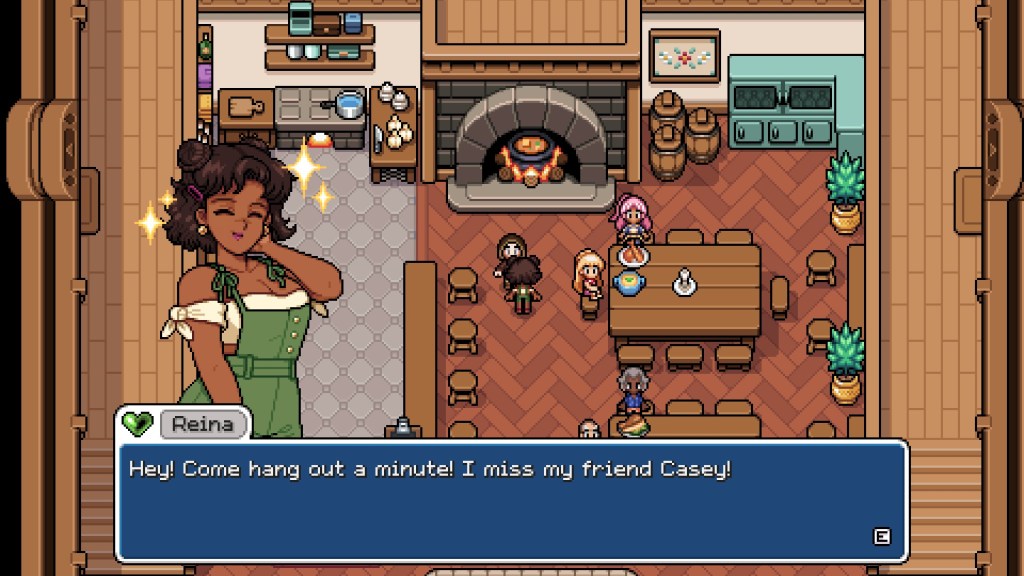
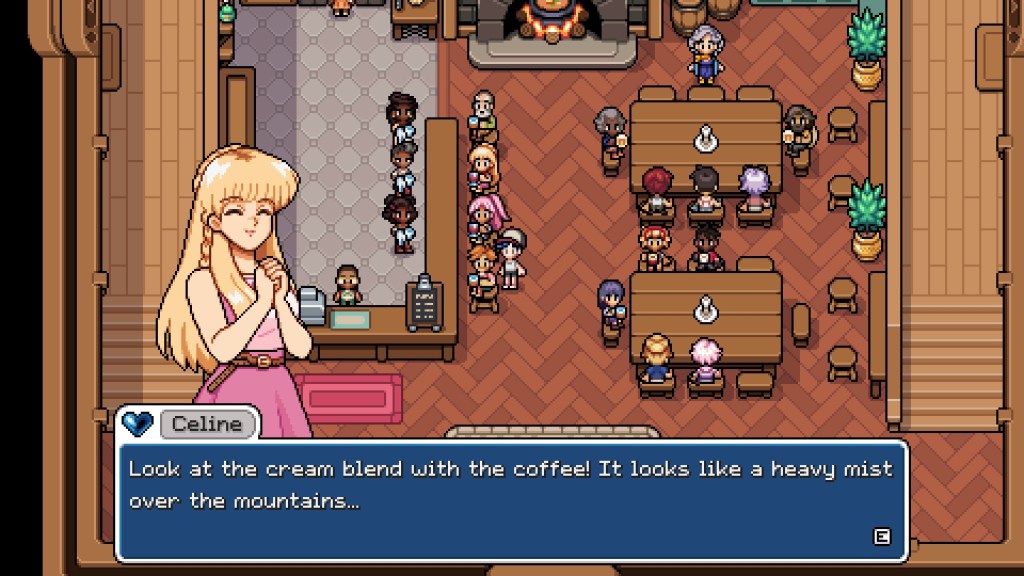
Because it is something that Fields of Mistria does incredibly well. While Stardew Valley tries to fake community by having the villagers stand facing each other, having shops close on different days, and holding different events that take place throughout the year such as the cookout and the flower dance, Fields of Mistria goes one step further by having the different villagers have scripted conversations with each other. This comes to a head every Friday evening when the people of Mistria gather in the inn for a regular gathering. There, players can see the townspeople together and get a real sense of how they all feel about each other.
You can watch Juniper and Valen flirt at the bar, Balor’s growing confusion as he gets dragged deeper into Eiland’s Dungeons and Dragons game, see the young members of the self-proclaimed “Dragonguard” plan a heist, or watch Olric beat everyone at cards without really knowing what he’s doing. While I would love to be able to be more involved with some of those activities (please NPC Studio, let me join the D&D game!) I still like how these Friday get-togethers flesh out the personalities of the villagers, letting players see how they act in their downtime. I like how it feels like this is a tradition that doesn’t necessarily need me, but how welcome I feel anyway – just another member of the community. I don’t think I’ve missed a single Friday catch-up, and each one feels fresh and rewarding to attend.
–
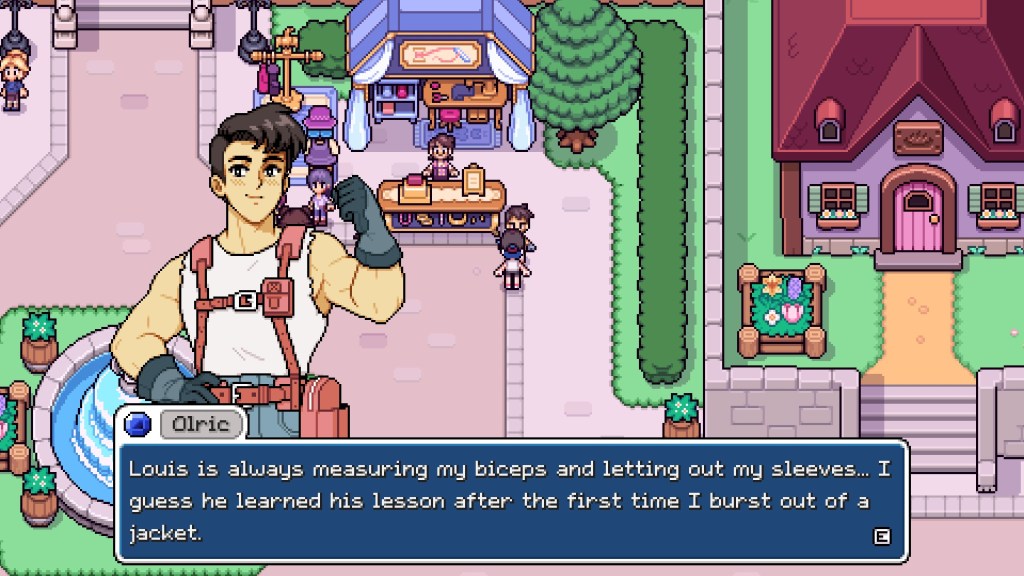
On a related note, the personalities of the villagers have made it easier for me to upgrade my relationship values with more or less everyone. When I play Stardew Valley I find I don’t spend much time levelling up my hearts with that many of the villagers, save for whoever it is I am romancing and maybe Willy the fisherman (shout out to an absolute bro). But, in Fields of Mistria, I’ve found that almost all my relationships are at two-hearts or higher without me having to put in much effort. I think some of this is due to a different balance on how closeness is calculated, but I think some of it is also the personalities of the characters. Everyone feels unique to talk to in Mistria. While some of the villagers in Stardew Valley do have very set personalities, they mostly feel quite generic. Nice, yes, but bland as well. In Mistria, everyone has a very present personality; Olric is a nice, if dumb, himbo. His brother March is outwardly hostile. Juniper is vain and more than a little snooty. Holt has a love of puns as deep as Hemlock’s love of music. It creates a compelling picture of the town, and makes me want to spend more time with these people, whereas most of the time in Stardew Valley I’ll just walk past the villagers as I go about my business.
Another design aspect that I like in Fields of Mistria is that the quests you pick up from the town notice board don’t decay and expire, such as in Stardew Valley. In Stardew, you have two days, no more or less, to get whatever items or slay however many monsters you need to kill to complete the quest. In Mistria, the quests don’t expire when you pick them up, allowing you more time to complete them and find what you need. Fields of Mistria also shows you the location of villagers on your map, making it easier for you to find them when you need to turn in items. This saves so much time, and is a really nice quality-of-life feature – it’s something that has to be modded into Stardew Valley, so to have it as a basic aspect of the game is great.
–
Before I return to Mistria, I want to give a shout-out to the amazing art which is present in the game. The character and environment concept artist for the game is Yuko Ota, whose work I’ve been in love with for many years, such as the slice-of-life webcomic Johnny Wander which she wrote with her husband (and fellow Fields of Mistria contributor) Ananth Hirsch.
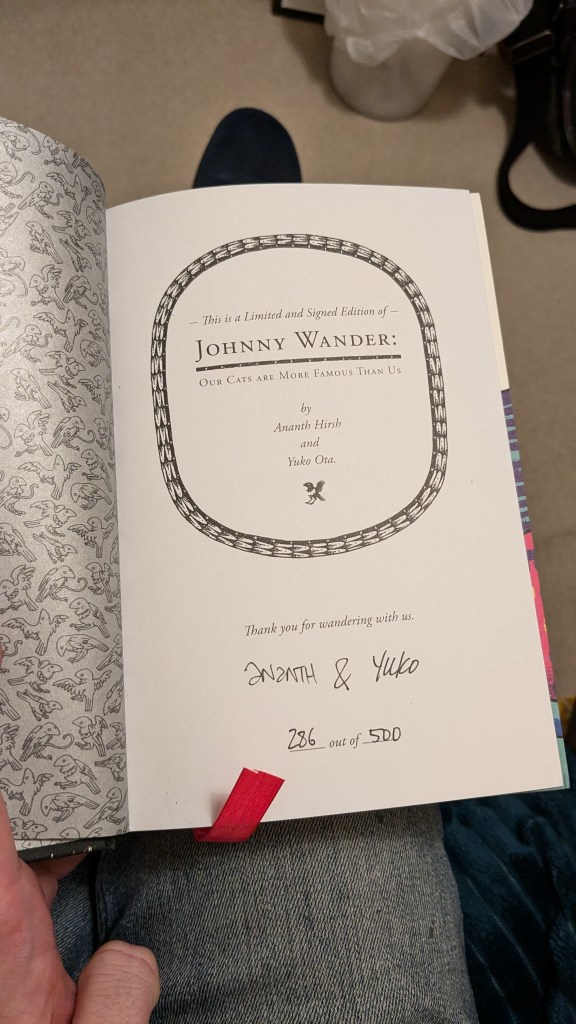
Ota’s artwork is something which originally drew me to Fields of Mistria and a lot of the affection I feel for the characters has to do with the work she has done on the game, alongside pixel artists Alina Sechkin, Emma Suen-Lewis and Victor Leão, and the other concept artists David Liu, Matt Cummings and Minoru Omura. Visual design is such a key part of making any game, and the work displayed in Fields of Mistria is top-notch.
–
As I was writing this, NPC Studio announced a new update for Fields of Mistria. This will apparently include a load of new features, such as romance, new clothing options and more events. I’m looking forward to seeing how this changes the game. The bones of Fields of Mistria are all present, and I can’t wait to see how NPC Studio adds to them. I can’t wait to see how it changes and grows, and how my relationship with it changes and grows with it.
 Correspondence From Limbo
Leave a comment